

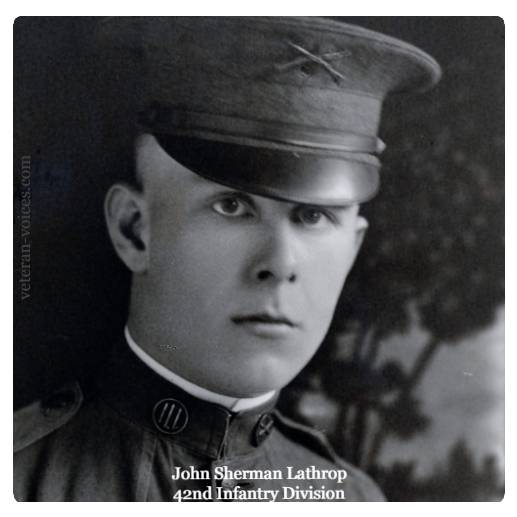


Battery F, 149th Field Artillery Bn., 42nd Infantry Division
John Sherman Lathrop was a student at the University of Illinois when the United States entered into the Great War. In addition to his course of study, he had also enlisted in the Illinois National Guard [Battery F, First Illinois Field Artillery] on 9 November 1915.
When President Woodrow Wilson began federalizing National Guard units, Battery F (and John Lathrop with it) reported for duty at Champaign, Illinois on 30 June 1917 and assembled with the rest of the First Illinois Field Artillery at Ft. Sheridan, Illinois a week later. John Lathrop was honorably discharged with a Surgeon’s Certificate of Disability on 17 July 1917, with “excellent character and good and faithful service.” However, the discharge didn’t seem to stick for long and he re-enlisted with the same battery and unit on 5 October 1917 at Camp Mills, Long Island, New York. By that time, the First Illinois Field Artillery had become the 149th Field Artillery Regiment (75mm) of the 42nd Infantry “Rainbow” Division.
Although the United States had entered into the war in April 1917, it only had a standing regular army of just over 127,000 men, who were scattered across the country and U.S. territories in regiments of about 1,000 men each. By late summer there were still no U. S. soldiers aiding the allies at the front, and the pressure was on to raise at least four full strength divisions and get them quickly to France. Both the New York and Pennsylvania National Guard were large enough to form divisions, but the War Department was concerned with showing either favoritism or slight by sending one to France first. An idea formed by then Major Douglas MacArthur solved the dilemma by raising a new division comprised of National Guard units from 26 states and the District of Columbia that would cross the United States “like a rainbow,” and the 42nd Infantry Division was born.
John Sherman Lathrop and the rest of Battery F, 149th Field Artillery Battalion, 67th Field Artillery Brigade, 42nd Infantry Division officially became part of the American Expeditionary Forces on 18 October 1917 when they boarded the President Lincoln at the Port of Hoboken, New Jersey. Upon arrival in France the 67th Field Artillery Brigade was detached at Camp Coëtquidan, France until February 1918.
Over the months that followed the 42nd Infantry Division participated in the Operations at Champagne-Marne, Aisne-Marne, St. Mihiel, and Meuse-Argonne; becoming, during that time, one of the most famous divisions of the war. [Note: The 67th Field Artillery Brigade was detached to the 4th Infantry Division during Aisne-Marne, and to both the 32nd and 2nd Infantry Divisions during parts of Meuse-Argonne.]
John Sherman Lathrop remained with Battery F, 149th Field Artillery Battalion for the duration of the war, but was returned to the United States at Newport News, Virginia in December 1918 aboard the USS Aeolus in a Casual Company of men who were sick and wounded. He was discharged from the Army at Camp Grant, Illinois in February 1919.
After the war, Lathrop returned to the University of Illinois and earned his degree in Ceramics Engineering in 1922. He removed, with his wife and children, to Los Angeles, California during the 1920s and was employed by the Vernon Pottery Company at the onset of World War II. He remained in Los Angeles until his death in 1964. John Sherman Lathrop was born in November 1897 at Chicago, Illinois to parents John C. B. Lathrop and Charlotte Cooley.
Sources:
- Center of Military History, Unites States Army, Order of Battle of the United States Land Forces in the World War, American Expeditionary Forces: Divisions (Washington, D. C. : Center of Military History, 1988), v. 2, pp. 272-286.
- Compiled service record, John S. Lathrop, 32031, Pfc., Battery F, 149th Field Artillery Battalion; Final Pay Voucher; Record Group 64: World War I Enlisted Men Final Pay Vouchers, 1917-1921; National Archives National Personnel Records Center, St. Louis, Missouri.
- Eric Durr, New York State Division of Military and Naval Affairs, “‘Rainbow Division’ that represented the United States formed in New York in August 1917,” United States Army, 24 July 2017 (https://www.army.mil/article/191270/rainbow_division_that_represented_the_united_states_formed_in_new_york_in_august_1917 : accessed 23 September 2019).
- Find a Grave, database with images (http://www.findagrave.com : accessed 23 September 2019), memorial 62582132, John Sherman Lathrop (1897-1964), Forest Lawn Memorial Park, Glendale, Los Angeles, California.
- Illinois Adjutant General’s Office, Roster of Illinois National Guard and Illinois Naval Militia as organized when called by the President for World War Service (Illinois : State of Illinois, 1929), 341; digital images, Illinois Digital Archives (http://www.idaillinois.org : accessed 23 September 2019).
- John Sherman Lathrop photograph, ca. 1917; privately held by Veteran Voices Military Research, [Address for Private Use], Tennessee, 2019.
- Library of Congress, “The American Expeditionary Forces,” Library of Congress Digital Collections (https://www.loc.gov/collections/stars-and-stripes/articles-and-essays/a-world-at-war/american-expeditionary-forces/ : accessed 23 September 2019).
- “U. S., Army Transport Service, Passenger Lists, 1910-1939,” database with images, Ancestry (https://www.ancestry.com : accessed 23 September 2019), entry for John S. Lathrop, 18 October 1917, President Lincoln; citing NARA Record Group 92: Records of the Office of the Quartermaster General, 1774-1985, College Park, Maryland.
- “U. S., Army Transport Service, Passenger Lists, 1910-1939,” database with images, Ancestry (https://www.ancestry.com : accessed 23 September 2019), entry for John S. Lathrop, 17 December 1918, SS Aeolus; citing NARA Record Group 92: Records of the Office of the Quartermaster General, 1774-1985, College Park, Maryland.
- “U. S. School Catalogs, 1765-1935,” database with images, Ancestry (https://www.ancestry.com : accessed 23 September 2019), entry for John S. Lathrop, 1916, University of Illinois; citing University of Illinois, Urbana-Champaign, Illinois.
- “U. S. WWII Draft Cards Young Men, 1940-1947,” database, Ancestry (https://www.ancestry.com : accessed 23 September 2019), entry for John S. Lathrop, Glendale, Los Angeles, California; citing NARA Record Group 147, Records of the Selective Service System, St. Louis, Missouri.